
 January
The Dementia,Cognition and Care Collaboration, held its final workshop. RAT Group’s Professor Gail Mountain and others facilitated a day focused on how to involve people living with dementia, and their relatives/supporters, in research.
The MALT study team launched their toolkit of resources for telehealth implementation and adoption. All of the tools are available via the MALT website. You can also view a short animation via this link.
February
 The Speech Therapy Apps for Rehabilitation (STAR) project started in February. The project is funded by the NIHR Invention for Innovation programme and is a collaboration between the University of
Sheffield, Therapy Box Ltd, Barnsley Hospital and Devices for Dignity.
The Speech Therapy Apps for Rehabilitation (STAR) project started in February. The project is funded by the NIHR Invention for Innovation programme and is a collaboration between the University of
Sheffield, Therapy Box Ltd, Barnsley Hospital and Devices for Dignity.
 The Speech Therapy Apps for Rehabilitation (STAR) project started in February. The project is funded by the NIHR Invention for Innovation programme and is a collaboration between the University of
Sheffield, Therapy Box Ltd, Barnsley Hospital and Devices for Dignity.
The Speech Therapy Apps for Rehabilitation (STAR) project started in February. The project is funded by the NIHR Invention for Innovation programme and is a collaboration between the University of
Sheffield, Therapy Box Ltd, Barnsley Hospital and Devices for Dignity.  |
| Prof Arlene Astell |
March
CATCH Professor Arlene Astell attended the WHO's first ministerial conference on dementia.
Research involving RAT group's Prof Gail Mountain and Dr Nasrin Nasr featured in Business Weekly on the 11thMarch, 2015:University of Hertfordshire scientists are part of a European team that have developed a prototype of a robotic glove which stroke suffers can use at home to support rehabilitation.
Adopt a Care Home Evaluation was showcased as part of the Festival of Science and Engineering.
April

Dr Jack Parker, Prof Gail
Mountain & Prof Sue Mawson published a paper in the Physical medicine and
Rehabilitation international journal entitled “The provision of feedback in
community stroke rehabilitation: the therapist’s perspective”
May
May 27th 2015 marked the first Technology
for Healthy Ageing and Wellbeing (THAW) event bringing together the general
public with those in the NHS, councils, charities and industry to discuss if
technology could be used to help older people to lead happier healthier lives.
 |
| From the left; Sheila Kennedy, Martyn Lewis, Deb Tanner, Tom Downs & Libby Archer. |
Sheila
Kennedy took part in a radio discussion about a Department of Health funded
research project aiming to improve acute hospital care for frail older
people.
Dr Katherine Easton collaborated with Inkwell Creative Arts Media, a volunteer
led enterprise offering media solutions and services, to produce a short
animation that explores the use of technology in mental health.
 |
| Dr Sarah Smith |
June
Staff from the Centre for Assistive Technology and
Connected Healthcare (CATCH)spoke and
exhibited at the prestigious annual King’s Fund Digital Health and Care Congress
July
 TaCT's Dr Matt Dexter facilitated a 24
hour Design Challenge: "As a facilitator, I had the luxury of watching
the whole event unfold without having to dive in and do the tough job of
creating a meaningful piece of Participatory Design over a single day."
TaCT's Dr Matt Dexter facilitated a 24
hour Design Challenge: "As a facilitator, I had the luxury of watching
the whole event unfold without having to dive in and do the tough job of
creating a meaningful piece of Participatory Design over a single day."
Launch of the first Telehealth
and Care Technologies Newsletter
Professor Gail Mountain presents "Old
Wine, New Bottles" at
Design 4 Health Conference.
 |
| Sarah Smizz's excellent interpretation of Professor Mountains talk. |
August
 100
participants were recruited into the multi centre trial "Big
CACTUS" led by RAT Groups, Dr Rebecca Palmer.
100
participants were recruited into the multi centre trial "Big
CACTUS" led by RAT Groups, Dr Rebecca Palmer.
RAT Groups Sarah Hargreaves graduated
with their PhDs.
September

TaCT
supported a short term secondment of Occupational Therapist Ali Madden-Fitzgibbon,
from the Assessment and Rehab Centre and Sheffield Health and Social Care NHS
Foundation Trust. Ali was placed with the ‘Valuing
Active Life in Dementia’ (VALID) research team in Sheffield, to develop her
research skills. Ali's secondment has now come to an end.
October
2015
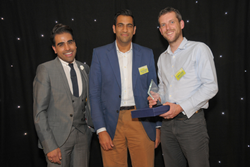 |
| Simon Judge (right), Medipex Awards. Image taken fromMedipex website. |
Researchers
test cutting edge technology with stroke and arthritis population: TaCT
Theme members tested innovative technology that feeds back on the way
people walk with those post stroke and arthritic knee pain groups.
Simon Judge was a joint winner of the digital
health category at the Medipex
Innovation Awards.
RAT, and CATCH presence at the AAATE
2015 conference in Budapest.

November 2015
The TaCT EnComPaSS project made a strong impact at
the Hospice
UK national conference in Liverpool
December
2015
Sam Kyeremateng (Medical
Director, St Luke's Hospice,
Sheffield and Consultant) and Judith Park (deputy chief executive and director of patient
care at St Luke's Hospice Sheffield, Chair of executive clinical leaders in hospice palliative care group) from St Luke's Hospice present at the Hospice UK2015 Annual Conference.
care at St Luke's Hospice Sheffield, Chair of executive clinical leaders in hospice palliative care group) from St Luke's Hospice present at the Hospice UK2015 Annual Conference.
The Adopt a Care Home
scheme was featured on Channel 4 News. Laura Di Bona and Sheila
Kennedy are involved in the development of this scheme and carried out an
evaluation of it. The scheme links people with dementia in care homes to local
children.
Dr Claire Craig gave a keynote
highlighting the importance of design in healthcare.
 |
| Dr Liz Williams and Prof Arlene Astell accept their award |
A CATCH project team was
amongst the nine Sheffield
Smart Lab winners that were announced at an awards ceremony in Sheffield.
The CATCH project team that was successful was Novel Assessment of Nutrition
and Ageing or NANA for short. NANA, led by CATCH academics Prof Arlene Astell
and Dr Liz Williams, is a system that monitors the nutritional intake and
cognitive function, mood and activity of older adults.


