

January
CLAHRC Director from Sheffield Invited to NIHR Parliamentary Open Day: Professor Sue Mawson was invited to represent all of the CLAHRCs in England to celebrate the NIHR's 10th Anniversary
Building on Palliative Care Services: The EnComPaSS project (Enhanced Community Palliative Care Support Services) has
developed a short video (see below) to explain in what way the projectaims to help build on current services to enable staff resources to be
used more effectively and more efficiently so that patients can die at
home, rather than hospital, if they wish.
 February
In conversation with Sheffield MP Paul Blomfield:
The University of Sheffield welcomed Sheffield Central MP Paul Blomfield on a visit to meet with leading health service researchers.
Strong CATCH / RAT / CLARHC representation at the Yorkshire and Humner Allied Health Professional Conference, 2016
Innovative Canadian palliative care approach implemented by U.K.-based hospice: EnComPaSS (Enhanced Community Palliative Support Services), which is led by Deborah Fitzsimmons from Western’s Faculty of Health Sciences, provides effective and cost efficient care for UK patients and their families in their own homes.
 March
MarchEnComPaSSing the Palliative Care Congress in Glasgow: The EnComPaSS palliative care project went live at St Luke’s Hospice, Sheffield on January 18th. Within the first month, 120 patients received 152 technology-enabled palliative care visits from Hospice community nurses. This achievement was celebrated at the 11th Palliative Care Congress at the Scottish Exhibition and Conference Centre, Glasgow.

April
University of Sheffield to host prestigious European conference on Assistive Technology in 2017
AcTo Dementia website launches: the primary focus is to recommend Accessible Touchscreen apps for people living with dementia.

May
Newborn screening – BMJ award finalists: A prevention category featured in this years BMJ awards and the CLAHRC supported Newborn Screening was short-listed.
June
 Pioneering technology designed to help transform independence will be showcased in Sheffield later this year at the UK's leading assistive technology conference: The Technology for Independence (T4I) Conference will be hosted by the University of Sheffield to showcase Assistive Technology (AT) related research and service innovation across health, education, employment and daily living.

Patient and public involvement event for stroke survivors and their carers: the Centre for Assistive Technology and Connected Healthcare (CATCH) held a patient and public involvement in research event for stroke survivors and their carers in the newly opened Diamond Building at the University of Sheffield.
 CATCH researchers take part in the UKspeech conference in Sheffield: 140 speech technology researchers took part in the 5th national UK speech conference on 20-21st June 2016. This year, the conference was organised by the Speech and Hearing Group, Department of Computer Science at the University of Sheffield.

Mario Muñoz Organero - my time in CATCH: For the last year here in CATCH we have been highly fortunate to be joined by visiting Professor Mario Muñoz Organero from Universidad Carlos III de Madrid, Spain where he is an Associate Professor in Telematics Engineering.
Professor Mark Hawley, Director of CATCH features in the current edition of the University of Sheffield’s Discover magazine: Speaking to the publication, Professor Hawley shared the centre’s aims: “Our goal is to help older people, people with disabilities and people with long-term health conditions to help themselves through the use of carefully designed and relevant technology,”

Consent Support Tool published!: We have published the Consent Support Tool, a practical resource designed to help health researchers seek informed consent from people with communication disorders. The tool provides a communication screening test, which researchers can use to identify potential participants’ communication needs.
AcTo Dementia World Tour: Researcher Phil Joddrell recently took the AcTo Dementia project on a world tour. Phil attended the 15th International Conference on Computers Helping People with Special Needs (ICCHP) in July to present work related to the AcTo Dementia project.

September
Dr Peter Cudd celebrates Research Institute Technology and Disability’s 25th anniversary in Germany: The Research Institute Technology and Disability (FTB), one of the founding members of the Association for theAdvancement of Assistive Technology in Europe (AAATE) celebrated its 25th anniversary in Düsseldorf, Germany.
CATCH Director, Prof. Mark Hawley attends Technology and Healthcare Innovation Symposium in the Netherlands: CATCH Centre Director, Professor Mark Hawley travelled to the Netherlands to join a symposium to mark the career of Professor Luc de Witte who leaves his role as Director for the Centre of Expertise on Innovative Care and Technology (EIZT) this week to take up the role of Chair within CATCH.

October
Professor Luc de Witte joins CATCH with big plans for the future: On Monday 3rd October we were delighted to welcome Professor Luc de Witte to the CATCH team.
CATCH’s Simon Judge awarded Honorary Fellowship in RCSLT annual honours: Simon Judge, Senior Clinical Scientist at Barnsley Hospital and Honorary Research Fellow within CATCH was last night presented with an HonoraryFellowship in the Royal College of Speech and Language Therapists’ (RCSLT) annual Honours Ceremony in London.
November
The Urban Slums Project team’s visit to India: As part of our international project “a mobile diagnostic and screening toolkit for urban slums settings”, a workshop was conducted on the 18th-19th of October 2016 in Bangalore, India.
December
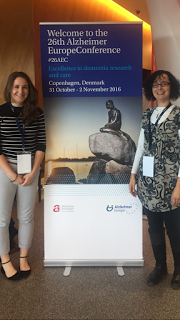
26th Alzheimer Europe Conference: Becky Field (Researcher, PhD student and Occupational Therapist) attends and gives presentation


